Applying for a job often feels simple. However, many candidates lose interview opportunities because of small but critical errors. These errors are common. Yet, employers notice them quickly. That is why understanding common job application mistakes is essential before sending your next application.
In today’s competitive job market, recruiters receive hundreds of applications for a single role. Therefore, they scan quickly. Because of this, even minor mistakes can lead to immediate rejection. Unfortunately, most candidates repeat the same errors without realizing it.
Moreover, many job seekers focus only on experience. However, employers evaluate much more than that. They look at clarity, attention to detail, and professionalism. Each section of your application sends a message about how you work.
If you want to increase your chances, you must understand what employers actually notice first. So, keep reading. The following sections explain the most frequent errors and how to avoid them, helping you submit stronger applications and move closer to interviews.
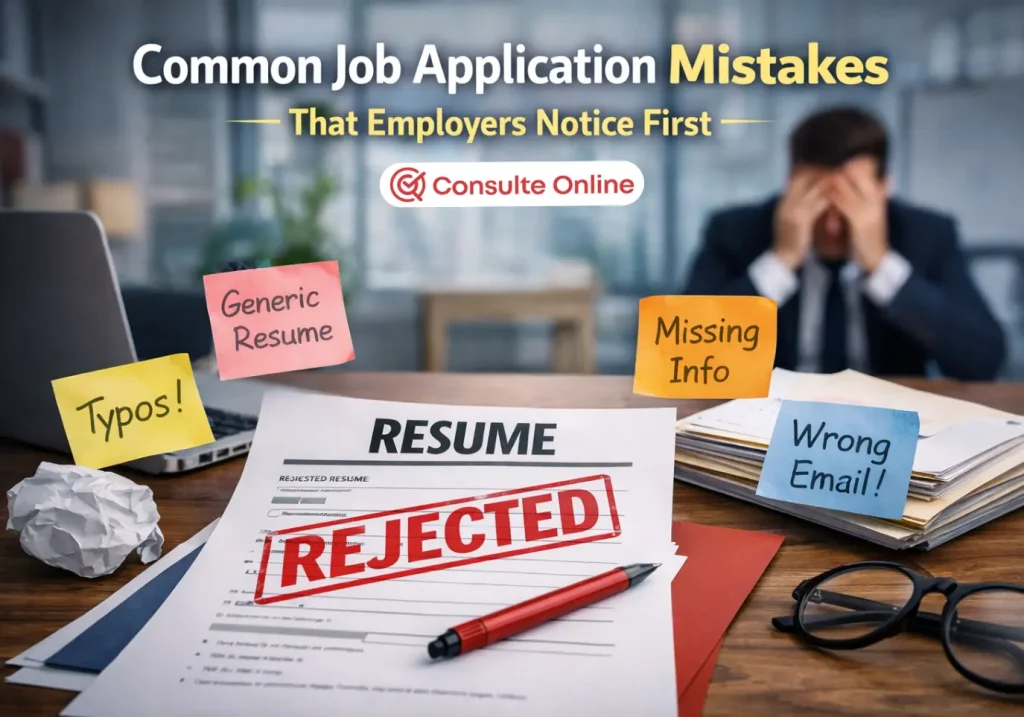
Common Job Application Mistakes Employers Notice Immediately
Recruiters notice mistakes fast. In many cases, they decide within seconds. Therefore, knowing what stands out negatively is crucial. Below are the most common job application mistakes that cost interviews.
Submitting a Generic Resume for Every Job
One of the biggest mistakes is using the same resume for all applications. While it saves time, it reduces relevance. Employers expect resumes to match the role.
Because of this, generic resumes often fail to highlight the right skills. As a result, recruiters may think the candidate lacks focus or interest.
Common signs of a generic resume include:
- Skills unrelated to the job
- No mention of the company or role
- Broad descriptions without results
To avoid this, adjust your resume for each position. Focus on relevant skills. Also, mirror keywords from the job description.
Ignoring the Job Description Details
Many candidates skim job descriptions. However, employers write them carefully. When instructions are ignored, it signals poor attention.
For example, some applications ask for specific formats or documents. Others request short answers or assessments. Ignoring these steps often leads to rejection.
Employers notice when candidates:
- Miss required documents
- Skip mandatory questions
- Submit incorrect file formats
Therefore, always read carefully. Then, follow every instruction exactly as requested.
Spelling and Grammar Errors
Spelling mistakes are among the most common job application mistakes. Although small, they create a strong negative impression.
Employers associate errors with carelessness. Even a single typo can raise concerns, especially for roles involving communication.
Frequent errors include:
- Misspelled company names
- Incorrect verb tenses
- Poor punctuation
To reduce errors, proofread slowly. Also, use spell-check tools. If possible, ask someone else to review your application.
Using an Unprofessional Email Address
Your email address is often the first thing employers see. Yet, many candidates still use casual or outdated emails.
Unprofessional emails reduce credibility. Employers may question maturity or seriousness.
Examples to avoid:
- Nicknames
- Numbers without meaning
- Humor-based addresses
Instead, create a simple email using your name. This small change improves professionalism instantly.
Poor Resume Formatting
Even strong experience can be ignored if the resume looks messy. Recruiters prefer clean and readable layouts.
When formatting is inconsistent, it slows down scanning. Because recruiters review many resumes quickly, they may skip confusing ones.
Formatting issues include:
- Too many fonts
- Dense paragraphs
- Lack of spacing
Use clear headings. Also, leave white space. Short bullet points improve readability.
Failing to Customize the Cover Letter
Many candidates either skip the cover letter or reuse the same one. However, employers notice generic letters immediately.
A strong cover letter connects your experience to the role. Without customization, it feels impersonal.
Common mistakes include:
- Using the wrong company name
- Repeating the resume word for word
- Writing overly long paragraphs
To improve, address the company directly. Explain why you fit the role. Keep it concise and focused.
Including Irrelevant or Outdated Information
Some resumes include details that no longer matter. Employers focus on relevance and current skills.
Examples of unnecessary information:
- Old jobs unrelated to the role
- Personal details not required
- Outdated software skills
Remove anything that does not support your candidacy. This keeps your application focused.
Applying Without Meeting Basic Requirements
Applying for roles without meeting minimum requirements is another common mistake. While ambition is positive, recruiters expect basic alignment.
If requirements are ignored, employers may think the candidate did not read carefully.
Before applying, check:
- Required experience level
- Certifications or licenses
- Legal work authorization
If you meet most but not all criteria, apply strategically. However, missing core requirements often leads to rejection.
Not Quantifying Achievements
Employers value results. However, many resumes list duties instead of outcomes.
For example, saying “managed a team” is vague. Adding numbers improves clarity.
Better examples include:
- Increased sales by 20%
- Reduced processing time by 15%
- Supported 50+ customers daily
Numbers provide context. Therefore, use them whenever possible.
Leaving Employment Gaps Unexplained
Employment gaps are common. However, unexplained gaps raise questions.
Employers notice gaps quickly. Without context, they may assume negative reasons.
To handle gaps:
- Briefly explain in the resume or cover letter
- Focus on skills gained during the gap
- Keep explanations short and honest
Transparency builds trust.
Using a One-Size-Fits-All Online Profile
Many employers review LinkedIn profiles. If your profile conflicts with your resume, it raises concerns.
Inconsistencies include:
- Different job titles
- Mismatched dates
- Outdated summaries
Keep profiles aligned. Update them regularly to reflect current goals.
Applying Too Quickly Without Review
Speed is important. However, rushing leads to mistakes.
Candidates often submit applications without reviewing attachments. This results in errors like:
- Wrong company name
- Incorrect resume version
- Missing documents
Before submitting, pause. Review everything carefully.
Overusing Buzzwords Without Context
Buzzwords sound impressive. However, without context, they lack meaning.
Employers see terms like “team player” or “hard worker” frequently. Without examples, they add little value.
Instead, show behaviors through actions and results.
Failing to Show Career Progression
Employers look for growth. If your resume shows the same role for years without change, it may raise questions.
Show progression by highlighting:
- New responsibilities
- Promotions
- Skill development
This demonstrates motivation and learning.
Not Tailoring Applications for Applicant Tracking Systems
Many companies use automated systems to screen applications. If your resume lacks relevant keywords, it may never reach a recruiter.
To improve compatibility:
- Use keywords from the job description
- Avoid complex graphics
- Use standard headings
This increases visibility.
Providing Incomplete Work History
Incomplete information creates confusion. Employers expect clear timelines.
Missing months or unclear roles slow down evaluation.
Ensure each role includes:
- Job title
- Company name
- Dates
- Key responsibilities
Clarity speeds decisions.
Applying Without Researching the Company
Employers expect candidates to understand the organization. When applications feel generic, interest is questioned.
Research helps you:
- Align your language
- Reference company values
- Ask better questions later
This shows preparation and motivation.
Using an Unclear or Weak Professional Summary
The summary is often read first. If it lacks focus, recruiters may stop reading.
A strong summary includes:
- Your role
- Key skills
- Career goal
Keep it short and specific.
Submitting Without a Final Review
Final reviews catch small mistakes. Skipping this step increases risk.
Before submitting:
- Check spelling
- Confirm attachments
- Verify contact details
This simple habit prevents avoidable errors.
Why These Common Job Application Mistakes Matter
Employers receive many applications. Therefore, they must filter quickly. Mistakes make decisions easier, but not in your favor.
Each error reduces trust. Combined mistakes almost guarantee rejection.
However, avoiding these errors improves your chances significantly. Attention to detail matters.
How to Improve Your Application Process
Improvement starts with awareness. Then, apply changes consistently.
Key steps include:
- Customizing each application
- Reviewing before submission
- Keeping documents updated
Over time, this increases interview invitations.
Table: Common Mistakes and Their Impact
| Mistake | Employer Perception | Impact |
|---|---|---|
| Generic resume | Lack of interest | High |
| Spelling errors | Carelessness | High |
| Ignoring instructions | Poor attention | Very High |
| Poor formatting | Hard to read | Medium |
| No customization | Low motivation | High |
Legenda: Common resume mistakes, how employers usually perceive them, and their potential impact on hiring decisions.
Conclusion: Avoiding Common Job Application Mistakes Builds Opportunities
Avoiding common job application mistakes does not require perfection. Instead, it requires awareness, preparation, and consistency.
Employers notice details because details reflect work habits. When your application is clear, relevant, and professional, it stands out positively.
By applying the strategies above, you improve your chances. More importantly, you move closer to interviews and career progress.
Relevant Links for Further Reading
- U.S. Bureau of Labor Statistics – Job Search and Employment Guidance
- U.S. Department of Labor – Career Development and Job Search Resources
- USA.gov – Find and Apply for Jobs in the United States
- Harvard University – Resume and Cover Letter Resources
- Society for Human Resource Management (SHRM) – Hiring and Recruitment Standards
📌 Read also:
Free Forklift Operator Certification How to Enroll in Free IT Courses Free Welding Courses in the US👉 Continue reading Consulte Online

