Finding a job in the United States often starts with one critical document. Your resume. For that reason, understanding resume tips for job interviews is essential if you want to stand out. Especially in a competitive market, small details can decide whether you get an interview or not.
Although many candidates have experience, they still struggle. This happens because U.S. employers follow very specific resume standards. Therefore, resumes that work in other countries often fail here. As a result, qualified applicants are frequently ignored.
However, the good news is simple. When you understand what recruiters actually look for, your chances increase. Moreover, when your resume follows the correct structure, it passes automated systems and reaches human eyes.
So, if you want practical guidance, keep reading. This article explains what truly works in the U.S. job market. Continue reading to learn how to adjust your resume with clarity and confidence.
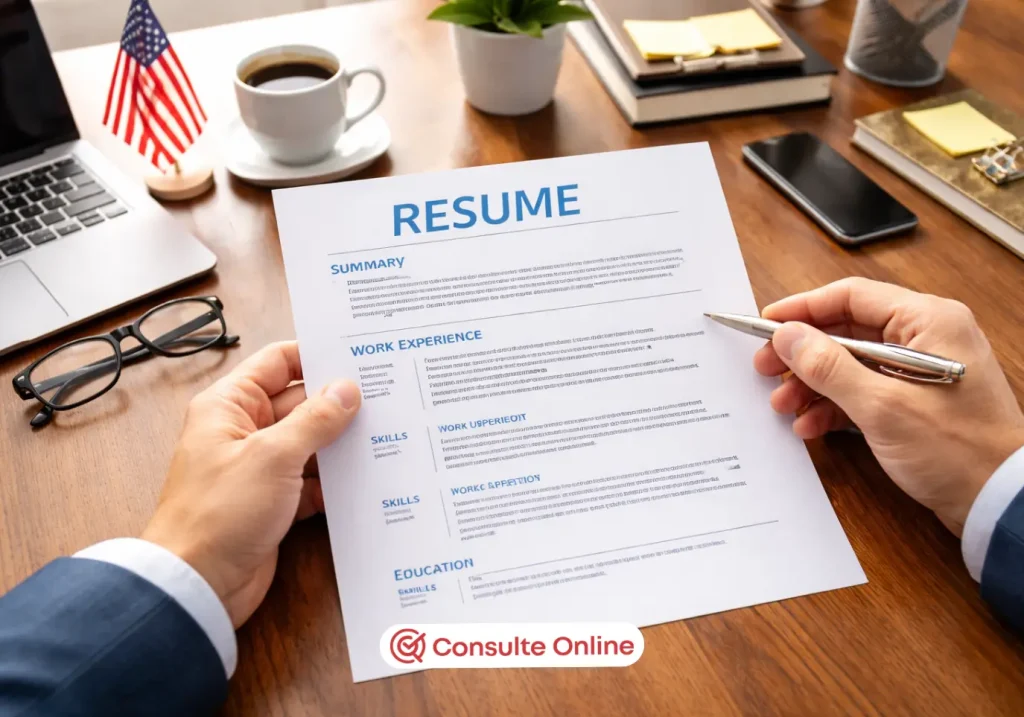
Resume tips for job interviews: how hiring works in the U.S.
Before writing a resume, it is important to understand how hiring works. In the United States, most companies use technology to screen candidates. Therefore, your resume must be designed for both systems and people.
Applicant Tracking Systems shape the first decision
Most employers rely on Applicant Tracking Systems, known as ATS. These systems scan resumes before a recruiter sees them. Because of this, formatting and keywords matter.
ATS software looks for:
- Job-related keywords
- Clear section titles
- Simple formatting
- Relevant experience
Therefore, complex designs often reduce your chances. Instead, a clean and structured resume performs better.
Recruiters spend very little time per resume
After passing the ATS, a resume reaches a recruiter. At this stage, time is limited. On average, recruiters scan a resume in seconds. Because of that, clarity is essential.
They focus on:
- Recent experience
- Measurable results
- Job relevance
- Clear job titles
As a result, resumes must be direct and easy to read.
Choose the correct resume format for U.S. employers
One of the most overlooked resume tips for job interviews is format choice. In the U.S., one format dominates.
Chronological resume is the standard
The chronological format lists your most recent experience first. This format is preferred by employers because it shows career progression clearly.
It works best when:
- You have consistent work history
- Your experience matches the job
- You are applying for entry-level or mid-level roles
Therefore, this format is the safest option for most applicants.
Avoid outdated or regional formats
Some countries use resumes with photos or personal details. In the U.S., this is discouraged. Including age, marital status, or photos can reduce your chances.
Avoid adding:
- Photos
- Date of birth
- Nationality
- Personal identification numbers
Instead, focus only on professional information.
Use clear section headings that recruiters expect
Structure matters as much as content. U.S. recruiters expect familiar sections.
Common sections include:
- Professional Summary
- Work Experience
- Skills
- Education
- Certifications
Because recruiters scan quickly, predictable headings help them find information fast.
Write a professional summary that attracts attention
A strong summary sets the tone of your resume. It should be short and focused.
Keep it concise and targeted
Your professional summary should be two or three lines. It must describe who you are and what you offer.
A good summary:
- Mentions your role or goal
- Highlights relevant skills
- Matches the job description
For example, instead of being generic, focus on job-specific value.
Highlight experience using results, not duties
Many candidates list tasks. However, U.S. employers value results. Therefore, your experience section should show impact.
Use action verbs and measurable outcomes
Each bullet point should start with a strong verb. Then, include results when possible.
Examples of strong verbs:
- Improved
- Managed
- Increased
- Coordinated
Whenever possible, add numbers. For instance, mention percentages, volumes, or time saved.
Resume tips for job interviews: tailor for every application
Sending the same resume to every job rarely works. Customization is essential.
Match keywords from the job description
ATS systems search for keywords found in job postings. Therefore, adapting your resume increases visibility.
Steps to customize:
- Read the job description carefully
- Identify repeated terms
- Include those terms naturally
This process improves ATS compatibility and recruiter interest.
Skills section: focus on relevance and balance
The skills section should support your experience. However, it must be realistic.
Combine technical and soft skills
U.S. employers value both technical abilities and soft skills.
Examples of technical skills:
- Customer service systems
- Microsoft Excel
- Inventory management
Examples of soft skills:
- Communication
- Time management
- Team collaboration
Balance is important. Avoid listing too many skills without evidence.
Education: keep it simple and honest
Education matters differently depending on the role. For entry-level jobs, it can help. For experienced roles, it becomes secondary.
Include:
- Degree or diploma
- Institution name
- Graduation year if recent
If you studied abroad, list the equivalent degree clearly.
Resume length: shorter is usually better
In the U.S., resumes are usually one page. This is especially true for entry-level positions.
Two pages may be acceptable if:
- You have extensive experience
- You apply for specialized roles
However, unnecessary details reduce impact. Therefore, focus on relevance.
Avoid common mistakes that block interviews
Many resumes fail due to simple errors. Avoiding them improves results.
Common mistakes include:
- Spelling errors
- Inconsistent formatting
- Long paragraphs
- Generic descriptions
Because recruiters notice details, proofreading is essential.
Use simple design and readable fonts
Design should support readability. It should not distract.
Best practices include:
- Use standard fonts
- Maintain consistent spacing
- Avoid graphics and tables that ATS cannot read
A clean layout improves both ATS scanning and human reading.
Resume tips for job interviews for candidates with no experience
Lack of experience does not mean lack of value. You can still build a strong resume.
Focus on transferable skills
Transferable skills apply across roles. For example:
- Customer interaction
- Organization
- Problem solving
Include internships, volunteer work, or school projects. These experiences demonstrate responsibility.
Explain employment gaps clearly
Employment gaps are common. In the U.S., honesty matters more than perfection.
Ways to explain gaps:
- Education or training
- Family responsibilities
- Job searching period
Keep explanations brief. Focus on what you learned during that time.
Proofread and review before sending
A polished resume reflects professionalism. Therefore, review carefully.
Steps to improve accuracy:
- Read aloud
- Use spell-check tools
- Ask someone to review
Even small errors can reduce credibility.
Prepare your resume for interviews, not just applications
Your resume should align with how you speak in interviews. Everything listed should be easy to explain.
Before interviews:
- Review your resume carefully
- Prepare examples for each role
- Practice explaining achievements
Consistency builds trust with interviewers.
Why these resume tips for job interviews really work
These tips reflect real hiring practices in the U.S. They align with how companies screen candidates. Moreover, they reduce common rejection reasons.
By following these steps:
- Your resume passes ATS filters
- Recruiters find information faster
- Interviews become more likely
Therefore, structure and clarity make a real difference.
Conclusion: build a resume that opens doors
A resume is more than a document. It is your first impression. When built correctly, it opens opportunities.
By applying these resume tips for job interviews, you improve visibility and confidence. More importantly, you present yourself in a way U.S. employers expect.
Take time to review and adapt your resume. Small changes can lead to meaningful results.
Relevant links for the reader to consult
- U.S. Bureau of Labor Statistics – Employment and job search guidance
- U.S. Department of Labor – Career and workforce resources
- USA.gov – Working in the United States
- U.S. Citizenship and Immigration Services – Employment authorization information
- CareerOneStop – Resume and interview preparation
- Indeed Career Guide – Resume Writing (U.S. market standards)
📌 Read also:
Free Forklift Operator Certification How to Enroll in Free IT Courses Free Welding Courses in the US👉 Continue reading Consulte Online

